The Strait of Hormuz is closed. What does that mean for your building materials order?
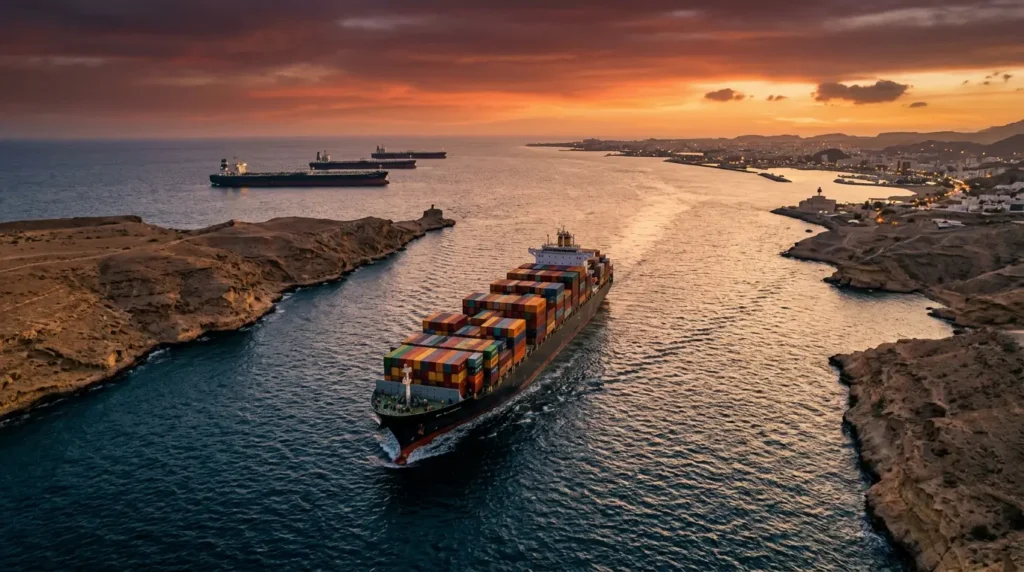

Two weeks ago, the US and Israel launched strikes on Iran. Iran hit back by mining the Strait of Hormuz and telling ships to stay away. Most of them listened. Tanker traffic dropped 70% within days, then went to zero. Maersk, MSC, CMA CGM, Hapag-Lloyd all suspended transits.
The short version for building materials buyers sourcing from China: FOB-related costs are up 10–25% on landed cost. War risk surcharges alone add $3,500 per container. But production lead times work in your favor. If you order now, the 45–90 day manufacturing window gives the crisis time to shift before your goods ship.
Here's the full breakdown: what's happening, what it costs, and what I'd actually do about it.
How the Strait of Hormuz closure is affecting oil prices
About 20% of the world's oil moves through the Strait of Hormuz every day, roughly 20 million barrels. When Iran's Revolutionary Guard started laying mines and warning off ships, that oil stopped flowing. Oil jumped from $70 to nearly $120 a barrel in a week. It's settled just under $100 now, but that's not stable, that's just less panicked.
Japan's Nikkei dropped over 5% in one session. China imports 11.6 million barrels of crude per day, and a big chunk normally comes through Hormuz. Iran says it's only blocking Western-allied ships and still sending oil to China. That doesn't matter much when insurers are pulling coverage for everyone.
Updated April 9: Oil crashed 11-16% the day the ceasefire dropped. Brent fell to $92-97. But physical crude was still above $150 on April 8, a $50+ gap between futures and actual barrels changing hands. The IEA released a record 400 million barrels from emergency stockpiles. The US temporarily lifted sanctions on some Russian and Iranian oil. JPMorgan warned prices could break $150 again if Hormuz stays disrupted into mid-May. Q1 2026 was the largest quarterly oil price increase, inflation-adjusted, since 1988.
Updated April 13: The ceasefire rally is over. Islamabad talks fell apart April 12. Trump announced a US naval blockade the same day. Brent jumped back to $101-103. WTI hit $104. Asian markets fell overnight. Saudi Arabia restored its East-West Pipeline but total capacity is still below pre-war. University of Michigan consumer sentiment hit a record low in April. Columbia's Karen Young said elevated oil prices are "for certain" through end of 2026.
War risk insurance and shipping surcharges
Updated April 9: This part has gotten worse since the original article.
All 12 members of the International Group of P&I Clubs cancelled war cover in the Gulf effective March 5. They cover 90% of the world's ocean-going tonnage. That cancellation hasn't been reversed.
Premiums dropped slightly after the ceasefire, from 1%+ to around 0.35-0.45% of hull value. Still painful. A $150 million LNG carrier pays $525,000-$675,000 per voyage in war risk alone. US and Israel-linked vessels pay three times that.
Hapag-Lloyd's War Risk Surcharge is now $3,500 per container. It was $1,500 when this article went up. Maersk says the conflict costs them $55 million a week. Neither has resumed Hormuz transits.
The US doubled its reinsurance backstop to $40 billion. The private market won't cover this, so the government did.
A European shipping executive told Bloomberg: "Insurance premiums are still sky-high, and no one wants to be the test case if things go wrong again." Windward Maritime Intelligence estimates weeks to restore 50-70% of traffic even in the best case. Months for anything close to normal.
Updated April 13: The blockade adds a new layer. Trump ordered the Navy to interdict any vessel that paid a toll to Iran. That is a direct hit on Chinese, Indian, and Pakistani ships that had been crossing with Iranian permission. Those are the same carriers that serve Foshan exporters. No insurer wants to write cover into a shooting gallery where both sides can stop you.
FOB prices from China are rising — here's by how much
Updated April 9: FOB costs from China are rising. Not because factories cost more to run, but because everything around the shipment got more expensive.
The numbers are worse than I originally estimated. Linesight confirmed 10-25% cost increases across construction materials (March 25 report). PVC pipes up 36%. Petrochemical feedstock from Chinese suppliers up 15%. Aluminium at 11-year premium highs. Singapore's construction sector is seeing 20% increases on renovation materials with a 3-5 year supply constraint forecast.
Cape of Good Hope is now the default route. Traffic past South Africa roughly doubled. Maersk, Hapag-Lloyd, CMA CGM all continue avoiding Hormuz. None have announced plans to resume.
Two things that didn't exist when I first published this. Qatar's Ras Laffan LNG facility took a direct hit from Iranian strikes: 17% capacity gone, 3-5 years to repair. LNG byproducts go into fertilizers, plastics, paints, building chemicals. A ceasefire doesn't fix that damage. Also, a drone hit the Saudi East-West Pipeline on April 8, the main alternative route for Gulf oil.
For building materials (ceramics, stone, steel, aluminum, fixtures), expect 10-25% on landed cost. That's up from 5-15% in the original version of this article.
Updated April 13: Recovery timeline just reset. The question used to be when Iran lets ships through. Now it is when both Washington and Tehran agree. Oil back above $100 means no relief on fuel surcharges either. And the new toll interdiction rule creates real compliance risk for Chinese and Pakistani carriers, which are the ones moving a lot of Foshan cargo.
How long will the Hormuz closure last?
Updated April 13: The talks failed. Islamabad ran 21 hours across April 10 and 11. JD Vance called it over on April 12. Iran "chose not to accept our terms," he said. The dealbreaker was nuclear enrichment. Iran wanted the right to enrich. The US said no. Lebanon and sanctions relief were the other sticking points.
Trump announced a US naval blockade the same day the talks collapsed. It starts April 13 at 10 AM ET. CENTCOM said traffic to non-Iranian ports can still pass. Iran's IRGC said any military vessel approaching the strait "will be dealt with harshly and decisively." The Wall Street Journal reports Trump is weighing fresh strikes on Iran. Senator Mark Warner on the blockade: "I don't understand how blockading the strait is somehow going to push the Iranians into opening it."
The ceasefire is technically alive through April 22. Nobody acts like it. Israel has five divisions in Lebanon. Lebanon's death toll is over 2,020. Iran calls the mine-clearing and blockade operations a ceasefire violation. No new talks are scheduled.
Earlier update, April 9: The April 7 ceasefire lasted about a day before it started cracking.
Israel launched Operation Eternal Darkness on April 8. 50 jets hit 100+ Hezbollah targets in Lebanon in 10 minutes. At least 182 killed. Iran called it a violation and briefly shut the strait again.
The numbers: 11 vessels transited in the first 24 hours. Normal is 60-135 per day. Two Chinese tankers (Cospearl Lake and He Rong Hai) are approaching at speed and may be the first laden tankers to try crossing. The IRGC posted mine-avoidance route maps, which tells you the mines are still there.
The US says the strait is open. Iran says passage requires IRGC coordination. Tom Kloza, energy adviser: "There's no indication that the strait is going to reopen. It seems like a flimsy ceasefire." He's probably right.
Islamabad peace talks, April 10-11. JD Vance leads the US side. Iran is sending Ghalibaf, Araghchi, and Pezeshkian. Iran's 10-point plan asks for uranium enrichment rights, full sanctions lifted, US troops out, war compensation. The Farsi version of the ceasefire says "acceptance of enrichment." The English version doesn't include that phrase. Trump, April 8: "There will be no enrichment of Uranium." They signed different deals.
Don't assume this ends soon.
Post-war Iran reconstruction: building materials demand outlook
This is the part I keep thinking about and don't see enough people discussing.
Iran's infrastructure is getting destroyed. Buildings, roads, energy facilities. When this ends — and it will — someone has to rebuild all of that. Iran's construction sector was projected to grow 3.9% annually through 2029 before the bombs started falling. Post-war reconstruction will push that number way higher.
That means demand for cement, steel, rebar, ceramic tiles, plumbing fixtures, aluminum, glass. China is Iran's biggest trading partner and the world's largest building materials exporter. When reconstruction contracts start getting signed, Chinese suppliers will be at the front of the line.
If you're a distributor in the Middle East, a contractor in a neighboring country, or just a buyer who plans ahead, this is worth watching closely.
How to order building materials from China during the Hormuz crisis
First, don't freeze. Waiting for "normal" is a bet that the war ends tomorrow and shipping costs drop overnight. That won't happen. Even after the fighting stops, surcharges and premiums take months to come back down.
Second, place production orders now. Chinese factories need 45–90 days for production. Start the clock. By the time goods are ready, the shipping picture should look different.
Third, track your tariffs. If you're shipping to the US or other markets with tariff policies, use our Tariff Tracker to calculate real landed cost. Tariffs plus war surcharges stack up fast if you're not watching the numbers.
Fourth, get quotes from multiple freight forwarders. Rates are all over the place right now. I've seen 20–30% differences between forwarders for the same route. Shop around and lock in where you can.
Fifth, think about post-war positioning. If your market could serve Iran's reconstruction, start building supplier relationships now. When the rush hits, lead times stretch and prices go up harder than they are today.
Bottom line for building materials buyers
Updated April 13. It got harder, not easier. Islamabad talks collapsed. Trump declared a blockade. Oil is back above $100. Nothing about this pushes carriers back into Hormuz.
Earlier update, April 9. Things didn't get simpler.
The ceasefire dropped and oil prices crashed. But physical crude is still above $150. Hapag-Lloyd's surcharge went from $1,500 to $3,500. No carrier has resumed Hormuz transits. Mines are still in the water.
If you placed orders during the crisis, factory prices are fine. Shipping is the open question. Maybe the Islamabad talks produce something. Maybe surcharges ease over weeks. Maybe Israel hits Lebanon again and Iran shuts the strait.
If you haven't ordered, the advice is the same: start production now. 45-90 days. By the time goods are ready, the shipping picture will look different.
Reconstruction is real but nobody knows the timeline. Qatar's LNG infrastructure needs 3-5 years. Iran took heavy damage. When rebuilding starts, material demand will be enormous. But that "when" could be months or years away.
Iran is also floating transit tolls of up to $2 million per ship for Hormuz passage. If that sticks, shipping costs go up permanently. Greece's PM called it unacceptable. China and the GCC are pushing back.
We help buyers source building materials from Foshan, from production through delivery. If you want to talk through your options, get in touch.
Frequently asked questions
How much are building materials FOB prices increasing because of the Hormuz closure?
Updated April 9: 10-25% on landed cost (Linesight, March 25 report). Up from the original 5-15% estimate. PVC up 36%. Petrochemical feedstock up 15% from Chinese suppliers. Aluminium at 11-year highs. Hapag-Lloyd surcharge doubled to $3,500/container. Insurance hasn't come down.
Should I wait to order building materials from China until the Hormuz crisis ends?
Updated April 13: No. Talks failed. The US just started a blockade. Windward Maritime Intelligence says weeks to restore 50-70% of traffic, months for full normalization, best case. Production takes 45-90 days. Use that window.
How long will the Strait of Hormuz stay closed?
Updated April 13: Islamabad talks collapsed April 12 after 21 hours. Trump declared a US naval blockade effective April 13 at 10 AM ET. The strait is now blocked from both sides. IRGC warned "harsh" response to any military vessel. Trump is reportedly weighing fresh strikes. No near-term end in sight.
What is the war risk surcharge on shipping containers through the Strait of Hormuz?
Updated April 9: $3,500/container (Hapag-Lloyd), up from $1,500. All 12 P&I Club members cancelled war cover March 5, not reversed. Premiums at 0.35-0.45% of hull value, down from 1%+ but still well above normal. US reinsurance backstop doubled to $40 billion.
FelixDeco is a building materials sourcing company based in Foshan, China. We work with international buyers on ceramics, stone, fixtures, and more. felixdeco.com
Sources:
- CNBC: Strait of Hormuz closure and shipping economy
- Al Jazeera: Maritime insurers cancel war risk cover in Gulf
- NPR: Iran war oil and energy crisis
- Fastmarkets: Strait of Hormuz lifts commodity freight rates
- CNN: Oil prices surge amid Iran war
- CNBC: Oil supertanker rates hit all-time high
- Al Jazeera: Trump says Iran war projected 4–5 weeks
- Fastmarkets: China steel exports to Persian Gulf face setback
- Seoul Economic Daily: Hormuz insurance premiums surge fivefold
- CNBC: US $20B reinsurance plan for Hormuz shipping
Sources — April 8-9, 2026 update:
- NPR: US and Iran agree to two-week ceasefire
- Time: Trump agrees to ceasefire with Iran
- Bloomberg: Dated Brent oil price hits all-time record
- Bloomberg: Shipowners eye Hormuz ceasefire window for 800 trapped vessels
- CNBC: Oil crashes below $100 on ceasefire
- CNN: Oil drops and stocks rally on Iran ceasefire
- NBC News: Ceasefire triggers oil price drop
- Linesight: Construction material costs up 10-25%
Sources — April 10-13, 2026 update:
- Reuters: US-Iran Islamabad talks collapse after 21 hours
- AP: Trump orders US Navy blockade of Strait of Hormuz
- CNBC: Oil surges on Hormuz blockade news
- Wall Street Journal: Trump weighs resuming strikes on Iran
- CNN: Karen Young on elevated oil prices through 2026
- Bloomberg: Vance says Iran talks failed over nuclear issue
- US CENTCOM: Hormuz blockade enforcement details
- Al Jazeera: IRGC warns response to military vessels
-
 Why Does George Building Have 72 Websites?11 Jun, 2026
 -
 Why Billionaire Jeffrey Epstein Sourcing Building Materials Keeps Pointing to Foshan09 Feb, 2026
 -
 The Strait of Hormuz is closed. What does that mean for your building materials order?15 Mar, 2026
 -
 What Jeffrey Epstein Bought From Foshan for his home furniture12 Feb, 2026
-
Why Does George Building Have 72 Websites?11 Jun, 2026
-
 What Do You Need Before Requesting a Custom Staircase Quote?15 Sep, 2026
 -
 Where Do Your Custom Carpets Actually Come From?18 Aug, 2026
 -
 How to Source Building Materials From Foshan, China: A B2B Buyer’s Guide12 Aug, 2026
 -
 What Should You Import from China or Leave to the Locals?05 Aug, 2026